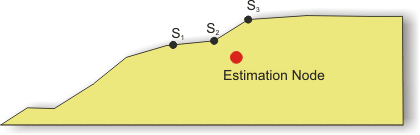
CUBE processing uses sounding propagation along with disambiguation to create and select hypotheses.
When soundings are propagated to a grid of estimation nodes:
• Soundings with a low vertical uncertainty are given more influence than soundings with high vertical uncertainty
• Soundings with a low horizontal uncertainty are given more influence than soundings with a high horizontal uncertainty.
• Soundings close to the node are given a greater weight than soundings further away from the node.
Generally, as soundings are propagated to a node, a hypothesis (depth value) is developed at that node. If a sounding’s value is not significantly different from the previous sounding then the same or modified hypothesis is used. If the value does change significantly, a new hypothesis is created. A node can contain more than one hypothesis.
In the above graphic, two soundings—S1 and S2—have similar values and therefore are part of the same hypothesis at the estimation node. However, sounding three (S3) has a significantly different value so it forms a new hypothesis.
Disambiguation
The final process in CUBE is disambiguation. Disambiguation selects one hypothesis over others. There are four disambiguation options:
• Density: Select the hypothesis with the greatest number of sounding samples.
• Locale: Select the hypothesis that is most consistent with the surrounding nodes that have only one hypothesis.
• Locale and Density: Select the hypothesis the contains the greatest number of soundings and is also consistent with neighbouring nodes.
• Initialization: Select the hypothesis that is nearest to a node value of a previously created surface. Initialization differs from the other methods because it filters potential outlier soundings just prior to disambiguation.
When a surface using the density and locale options is generated, two layers specific to the CUBE surface are displayed.
• The Hypothesis Count layer is a visual representation of hypothesis density at a node. A Surface with a Hypotheses Count layer is displayed below.
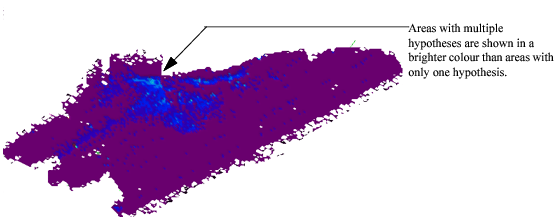
• The Hypothesis Strength layer is a visual representation of the mathematical confidence of a chosen hypothesis. Each node is given a value ranging from 0.0 (high confidence) to 5.0 (low confidence). Nodes with one hypothesis have a confidence value of 0.0 while nodes with multiple hypotheses will have confidence values greater than 0.0. A Hypothesis Strength layer is displayed below.
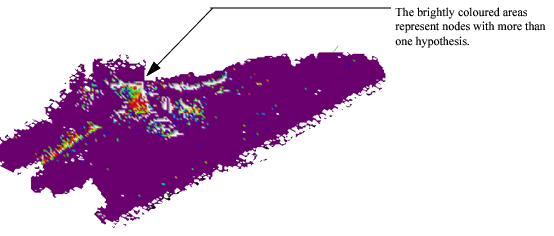
More than one hypothesis or a low confidence value does not necessarily mean an error. Uneven areas (slopes, for example) show more than one hypothesis because of the changing terrain. Nodes with multiple hypothesis should be examined in the Subset Editor. See Hypothesis Cleaning.
When you select the Initialization method of disambiguation, two additional layers are created:
• Guide_Depth: Depths from the initialization surface.
• Guide_Uncertainty: Vertical uncertainty values from the initialization surface.
The User Nominated layer displays the nominated hypotheses that were chosen over the hypotheses selected by CUBE disambiguation (see Alternative Hypotheses).