Additional attributes (that is, attributes available in the source file that are not XY position or Depth) can also be defined in the info file. The options for these attributes can be set in the additional attributes section.
The file named XYZ++ Format Information File.info in the installed Template directory contains an example of additional attributes.
The following additional attribute types are supported:
• String
• Number
• Date
• Time
• Uncertainty
• Colour
The following data types are supported, as can be seen in the sample file provided
<!-- The information required to decode the attributes --> <Attributes>
<!-- Available Data Types --> <!-- 4 byte real value (FLOAT) --> <!-- 8 byte real value (DOUBLE) --> <!-- 2 byte unsigned integer value (USHORT) --> <!-- 2 byte signed integer value (SHORT) --> <!-- 4 byte signed integer value (INT) --> <!-- 4 byte unsigned integer value (UINT) --> <!-- 1 byte unsigned char value (UCHAR) --> <!-- Hour time value (TIME_HOUR) --> <!-- Minute time value (TIME_MINUTE) --> <!-- Second time value (TIME_SECOND) --> <!-- Year date value (DATE_YEAR) --> <!-- Month date value (DATE_MONTH) --> <!-- Day date value (DATE_DAY) --> <!-- String value (STRING) --> <!-- Red portion of a colour (COLOUR_RED) --> <!-- Green portion of a colour (COLOUR_GREEN) --> <!-- Blue portion of a colour (COLOUR_BLUE) --> <!-- Aplha portion of a colour (COLOUR_ALPHA) -->
|
The positional (XYZ) attributes in an INFO file are predefined. However, when using an additional attribute with multiple data types, each data type must be defined by the user.
For example, the TIME and DATE attributes each have multiple pieces of data that make up their over-all values (hour/minute/second, day/month/year). Each of these pieces of data is a different data type and must be identified individually.
Similarly, to create a single attribute layer called “Colour” in the resulting CSAR file, each of the Red, Green, and Blue portions in the XYZ file are defined. The Alpha portion, which is the transparency value, is optional.
When defining each data type, you have the same options as defining a position attribute: column index value, or start and width values for a character array. The difference is that you must complete all fields for each data type as if it were an attribute itself.
For user defined time and date type attributes: The width is always the number of characters from the Start_Pos. |
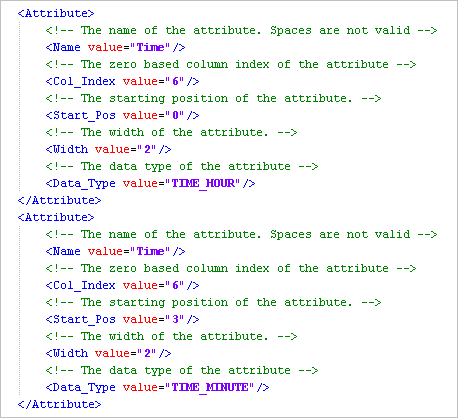
The following example shows TIME_HOUR and TIME_MINUTE, defined using Col_Index and a delimiter.
In order for the Import tool to recognize which attribute the data type belongs with, you must identify the Name value of the attribute (“Time”) and the Data_Type value of the data (“TIME_HOUR”).
The same column number is referenced for each piece of data, but a start and width value have been specified for the characters of each piece of data within the column.
When specifying the number of characters this way, the numbering starts over at the beginning of each column.
• TIME_HOUR = Column 6, Start 0, Width 2
• TIME_MINUTE = Column 6, Start 3, Width 2
• TIME_SECOND = Column 6, Start 6, Width 6
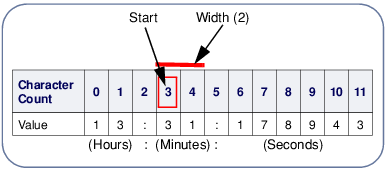
Note that a character is used as a delimiter between each value within the column and included in the character count; however, it is not included in the value in the surface. |
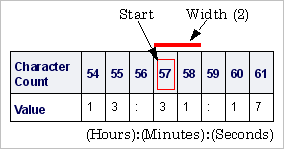
If there were no delimiter value specified in the INFO file, each piece of data would need to be identified using the character count of the entire line. For example, TIME_MINUTE may start at character 57 and have a width of 2. TIME_SECOND would then start at 60 with a width of 2.
See the XYZ++ Format Information File.info file for examples of how the other additional attributes are entered.