Note: A surface will need to be re-generated if Georeference Bathymetry is re-applied.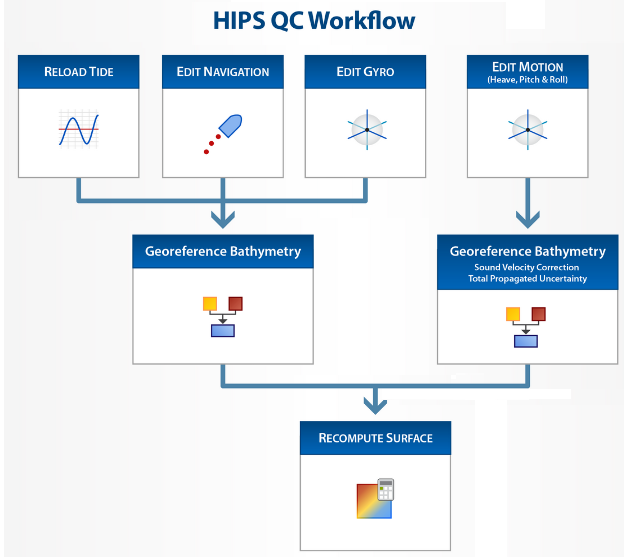
Problems with sensor offsets, auxiliary sensor data, and so forth, become readily apparent in the surface. Relying on a surface to highlight problems in the auxiliary sensors can improve processing efficiency, because you are no longer required to investigate the motion and navigation for each survey line.
In the HIPS multibeam workflow, the auxiliary sensor data was not investigated prior to creating the surface. So at this point, you can use the surface to highlight problem areas that may exist.
Certain edits, for example, if you reload tide, edit navigation or edit gyro will require that Georeference Bathymetry be applied to the data again.
If needed, you can split the track lines into groups for inclusion or exclusion from editing, as described in Hiding and Displaying Track Lines for Processing.
If you edit heave, pitch or roll in Kongsberg data, you will need to re-apply Sound Velocity Correction.
Note: A surface will need to be re-generated if Georeference Bathymetry is re-applied.