Tool | CZMIL > 09 - Generate Turbidity and Reflectance Outputs (Tools window) |
The Generate Turbidity and Reflectance Outputs process model is used to generate turbidity and/or reflectance images and/or surfaces using CZMIL data.
CARIS Batch process: N/A
Interface
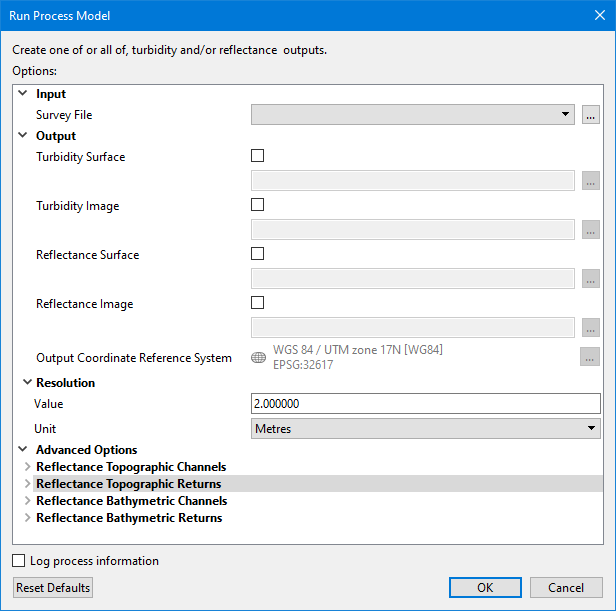
The options in this process model include:
| Option | Description |
|---|---|---|
Input | Survey File | The name and location of the survey file containing the survey lines of CZMIL data. If a survey file is open in the application, a drop-down list is also provided for this option. The drop-down list allows a survey layer open in the application or the current selection (if a survey line is selected) to be used as the input survey. 1. Click the browse button (...) to launch an Open file dialog box. 2. Navigate to the relevant file. 3. Click Open. |
Output | Turbidity Surface | Enable this option to generate a raster surface using the turbidity values in a CZMIL dataset. A name and location for the new turbidity surface file must be specified. 1. Click the check box to enable the option. 2. Click the browse button (...) to launch an Save file dialog box. 3. Specify a name and location for the surface. 4. Click Save. |
Turbidity Image | Enable this option to generate a raster image in TIFF format using the turbidity values in a CZMIL dataset. A name and location for the new turbidity image file must be specified. 1. Click the check box to enable the option. 2. Click the browse button (...) to launch the Save file dialog box. 3. Specify a name and location for the file. 4. Click Save. | |
Reflectance Surface | Enable this option to generate a reflectance surface using the reflectance values in a CZMIL dataset. A name and location must be specified for the resulting .csar surface. By default, the file will be created using the same name and location as the survey file. 1. Click the check box to enable the option. 2. Click the browse button (...) to launch an Save file dialog box. 3. Specify a name and location for the surface. 4. Click Save. | |
Reflectance Image | Enable this option to generate a reflectance image in TIFF format using the reflectance values in a CZMIL dataset. A name and location must be specified for the resulting image file. By default, the file will be created using the same name and location as the survey file. 1. Click the check box to enable the option. 2. Click the browse button (...) to launch an Save file dialog box. 3. Specify a name and location for the image file. 4. Click Save. | |
Output Coordinate Reference System | The coordinate reference system (CRS) that will be used to create the output image and/or surface. 1. Click the Browse button (...) to launch the Select Coordinate Reference System dialog box. 2. Select a CRS from the list. 3. Click OK. | |
Resolution | Value | The ground resolution that will be used to create the turbidity and/or reflectance output. 1. Type a value in the field. |
Unit | The unit of measure that will be used for the resolution value used to generate the turbidity and/or reflectance output. 1. Select a unit of measure from the drop-down list. | |
Advanced Options | Reflectance Topographic Channels | The topography data channels of the data returns from which values will be read when generating the output surface and/or image. 1. Click to populate the check box of each channel to be included. |
Reflectance Topographic Returns | The topography data returns in the survey data from which values will be read when generating the output surface and/or image. 1. Click to populate the check box of each return to be included. | |
Reflectance Bathymetric Channels | The bathymetry data channels of the data returns from which values will be read when generating the output surface and/or image. 1. Click to populate the check box of each channel to be included. | |
Reflectance Bathymetric Returns | The bathymetry data returns in the survey data from which values will be read when generating the output surface and/or image. 1. Click to populate the check box of each return to be included. | |
Log process information | Create a log file containing the options specified when the process was run. The location of the log file is determined by the Logs setting in Tools > Options > Files and Folders. 1. Click the check box to enable this option. | |
Procedure
1. Double-click the Generate Turbidity and Reflectance Outputs process model in the Tools window.
The Run Process Model dialog box is displayed, populated with the Generate Turbidity and/or Reflectance Outputs process model.
2. Navigate to the relevant Survey File.
3. Click the check box of the product type(s) to be created.
4. Specify a name and location for each product being created.
5. Specify the Resolution Value and Unit.
6. Select the Output Coordinate Reference System for the output.
7. Select the Topography Channels and Returns to include.
8. Select the Bathymetry Channels and Returns to include.
9. Click OK.
A progress dialog box is displayed providing progress information as the images are generated. Similar information is also reported in the Output window.
10. When finished, click the Close button to close the dialog box and complete the process.