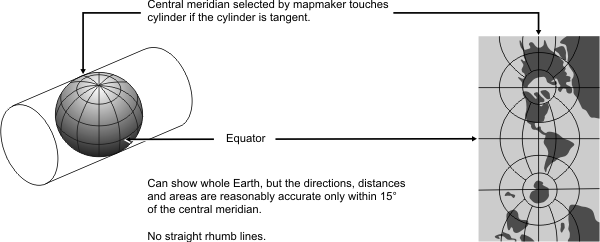
General | Can be joined at their edges only if they are in the same zone with one central meridian. Also used for mapping large areas that are mainly north-south in extent. Graticule spacing increases away from the central meridian. The equator is straight, but other parallels are complex curves concave toward the nearest pole. The central meridian and each meridian 90 degrees from it are straight. Other meridians are complex curves concave toward the central meridian. The map is conformal. |
Directions | Reasonably accurate within 15 degrees of the central meridian. |
Distances | True only along the central meridian selected by the mapmaker or along two lines parallel to it. Reasonably accurate within 15 degrees of the central meridian. Distortion increases rapidly outside the 15° band. |
Areas | Reasonably accurate within 15 degrees of the central meridian. Distortion increases rapidly outside the 15° band. |
Shapes | Reasonably accurate within 15 degrees of the central meridian. Shapes and angles within any small area are essentially true. Distortion increases rapidly outside the 15° band. |
Type | Cylindrical. Mathematically projected onto a cylinder tangent to a meridian. The cylinder may also be secant |
History | Presented by Johann Heinrich Lambert in 1772. |
| |
Note | Directly supported. |
(United States Geological Survey, n.d.) | |