Menu | Tools > Engineering Analysis > Volumes > Comparative |
Tool |
|
Menu | Tools > Engineering Analysis > Volumes > Comparative |
Tool |
|
The Comparative Volumes command allows you to compute the difference in volume above a model between two TIN coverages. This option is useful in determining the amount of change that has happened; for example, the amount of material that has been dredged, or the amount of deformation that has occurred.
You can choose to use a reference model surface or an infinite plane as the reference for volume calculation. When using a reference model surface, the Depth of the surface points and the Allowance Below attributes will be used. When using an infinite plane, you must specify the Depth of the plane and the Allowance value to be used. If neither option is used to define the area for computation, a value below all of the data is used.
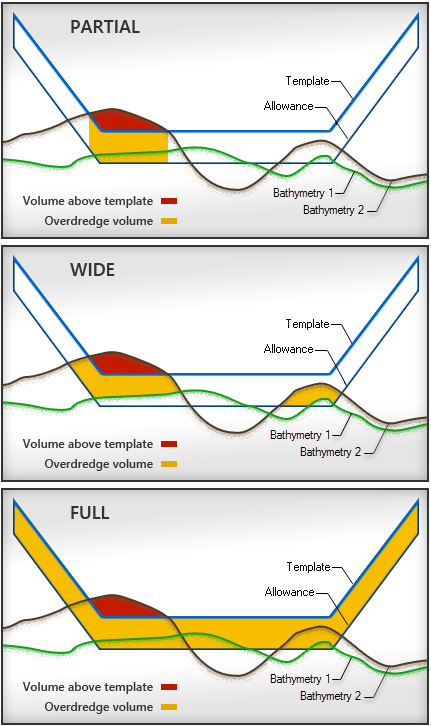
Allowance volumes are calculated using one of three algorithms, however, you can also opt to not apply an algorithm. The three algorithms provided are:
• Partial Bottom: Calculates allowance volume only for the area of the model which has excess volume at the model depth.
• Wide Bottom: Calculates the allowance volume for the area of the model that has excess volume at the allowance depth/height. The allowance volume reflects the actual volume of material between the allowance depth/height and the model depth.
• Full Bottom: Calculates allowance volume for the entire model area regardless of the location of the material to remove.
An example of each option is shown below.
The results of the calculation will be saved to an XML file that can be reopened at a later date. By default, the file will be saved to the Windows Temp folder the first time the command is run.
C:\Users\<username>\AppData\Local\Temp
If you choose to save to a different directory, that directory will be selected by default the next time the command is run.
The results will be displayed in the following dialog box. See Open Volume Results for information on this dialog box.
Related commands:
• Volumes
Interface
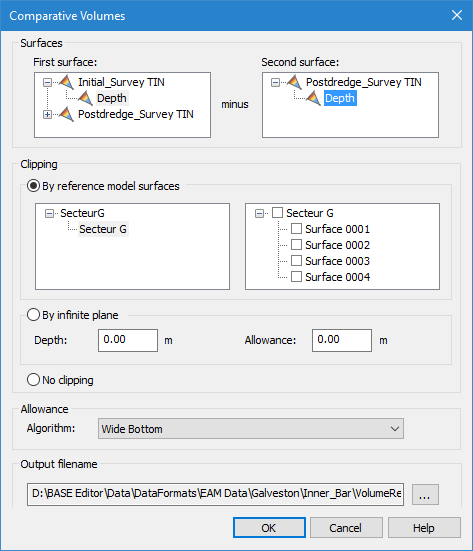
The Comparative Volumes command uses the following dialog box.
Option | Description |
|---|---|
Surfaces | The TIN coverages created from the surfaces whose volumes you wish to compare. The Second surface selection will be subtracted from the First surface selection to calculate the difference. Once a TIN is selected from the first list, only the TINs available for comparison are displayed in the second list. Note that the same TIN cannot be selected for both coverages, and that if one TIN is created from a raster surface gridded relative to a plane, the second TIN must have been created from another raster surface gridded relative to the same plane. |
By reference model surfaces | This option is used if calculating volumes using the surfaces of a reference model as the reference plane. The list on the left displays all reference models currently open in the application and their templates. Once a template is selected, the list on the right displays the surfaces included in the selected template. Each surface to be used for the volume calculation can then be selected in the list. |
By Infinate Plane | This option is used if calculating volumes using an infinite plane. When using this option, you must specify depth and allowance values for the reference plane. |
Depth | The depth value to assign to the infinite plane. This option is only enabled if the Infinite plane volume calculation method is selected. |
Allowance | The allowance value to assign to the infinite plane. This option is only enabled if the Infinite plane volume calculation method is selected. |
No clipping | Select this option if you do not want to limit the volume computation to a reference plane. |
Allowance Algorithm | The agorithm to use for calculating allowance volumes. |
Output filename | The name and location for the volume results XML file. 1. Click the browse button (...). 2. Navigate to a location for the file and enter a file name. 3. Click Save. |
Procedure
1. Open the two surfaces for which you want to compare volumes.
2. Ensure that a TIN has been created for each.
3. [Optional] To use the Clipping by reference model surfaces option, open a reference model.
4. Select the Comparative Volumes command.
The Comparative Volumes dialog box is displayed.
5. Expand a TIN in each list and select the appropriate layer.
Select a clipping option.
If applying clipping, either:
• click the check boxes of the desired reference surfaces in the Reference model surfaces list, or
• enter Depth and Allowance values for the infinite plane.
6. Select an option from the Allowance Algorithm list.
7. Define the name and location for the volume results file.
8. Click OK.
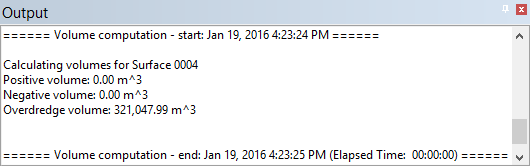
A progress bar will be displayed to track the progress of the calculation. As each selected surface is calculated, the results will be displayed in the Output window as raw data, meaning values have not been rounded or converted to the unit of measure being used in the application. If volume cannot be calculated for any reason, the name of the problematic surface will be output with an error message as the last entry in the Output window and the operation will stop.
When all calculations have finished, the results will be displayed in the Volume Results dialog box and saved to the specified XML file.
