Menu | File > Import > Import Selected Objects > Superselection/Selection |
Import selected vector features from a layer containing S-57 data into another layer, which can be a scratch or feature layer.
The features are added to the target layer and assigned new feature object IDs. External files are copied to the folder referenced by the externalFiles variable.
Both layers must be open.
Related commands:
Interface
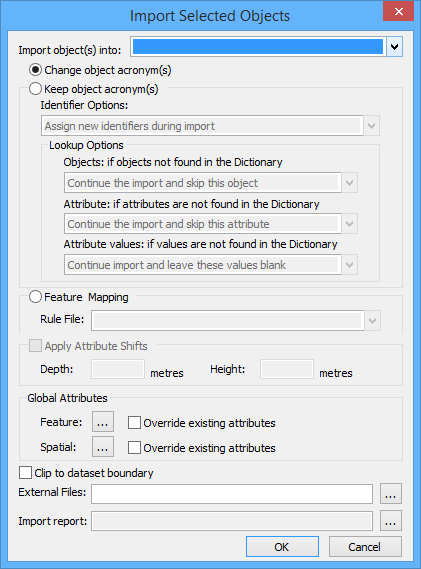
The Import Selected Objects command uses the following dialog box.
Option | Description |
|---|---|
Import objects into | The layer into which the objects will be imported. Select from the list. |
Change object acronyms | Enable this option to manually select the object acronym and attribute values to be assigned to the imported objects. With this option is selected, additional dialog boxes are displayed when you click OK. These dialog boxes are used to select the object acronym and enter attribute values. |
Keep object acronyms | Retain existing acronym and attribute values. • Identifier Options: Choose to assign new feature object IDs or use existing object IDs. Select from the list. • Use existing identifiers (skip object if identifier already in use). • Use existing identifiers (assign new object identifiers if identifier is already in use). • Assign new identifiers. • Lookup Options: Choose what to do if objects, attributes, or attribute values in the imported data are not found in the dictionary. Select from the list |
Feature Mapping | Use an XML mapping file to assign acronyms and attributes to objects. This can be a one-to-one conversion, one-to-many conversion, or a many-to-one conversion. 1. Select the file from the list. |
Apply Attribute Shifts | Shift depth or height values for attributes with sounding or vertical datum types. This option is active only if you select Keep Object Acronyms or Feature Mapping. • Depth: Type the depth shift value in the box. Put a plus sign (+) in front of the value to make it deeper or a minus (-) sign to make it shallower. • Height: Type the height shift value in metres in the box. Put a plus sign (+) in front of the value to make it higher or a minus (-) sign to make it lower. |
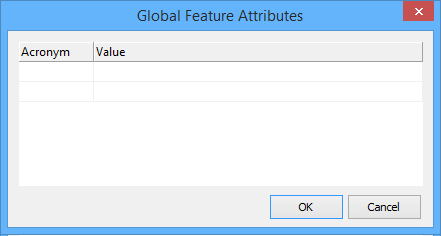
Global Attributes | Attributes that can be applied to all features during import. You can choose feature attributes, spatial attributes, or both. Feature: To apply global feature attributes: 1. Click browse (...). The Global Feature Attributes dialog box is displayed.
2. Select an attribute acronym from column 1. 3. Enter a value in column 2. 4. Click OK. 5. Enable Override Existing Attributes to replace values if the same attributes are used in the imported features. |
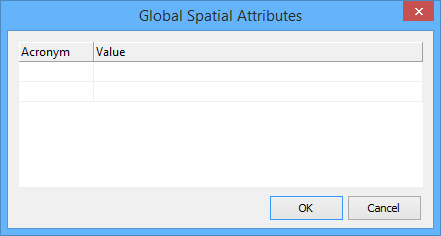
Spatial: To apply global spatial attributes: 1. Click browse (...). The Global Spatial Attributes dialog box is displayed.
2. Select an attribute acronym from column 1. 3. Enter a value in column 2. 4. Click OK. 5. Enable Override Existing Attributes to replace values if the same attributes are used in the imported features. | |
Clip to dataset boundary | On: Only features that fall within the dataset boundary are imported. Line or area features that extend beyond the boundary are clipped at the boundary. Off: All features are imported in their entirety. |
External Files | If the dataset contains external files located in a different directory (for example, text and multimedia files referenced by the TXTDSC and PICREP attributes), use this option to select the directory where these files are located External files will be copied to the directory referenced by the 1. Click browse (...) and select a path, or type the path directly in the text box. |
Import report | To generate a report of the import, click browse (...) and select a path and file name for the report. |
Procedure
1. Select the layer containing the data to be imported.
2. Select one or more features.
3. Select the Import Selected Objects command.
The Import Selected Objects dialog box is displayed.
4. Select the layer to which data is to be imported.
5. Select an import option:
• Change object acronym(s)
• Keep object acronym(s)
• Feature Mapping
6. Define the settings for the selected import option.
7. Set any other necessary options.
8. Click OK.
The feature objects are imported to the selected feature layer.