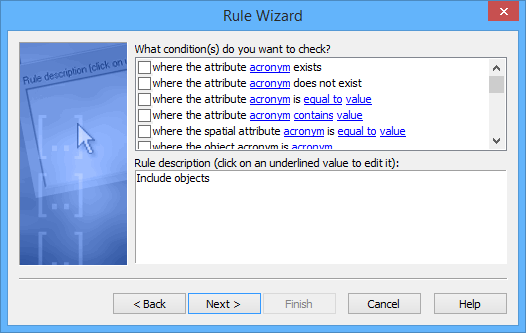
The list at the top contains the conditions that can be applied.
Procedure
1. Select one or more conditions.
Selected conditions are displayed in the list at the bottom.
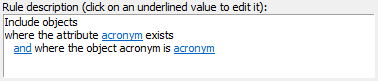
Certain terms in the conditions are hyperlinks. You use these links to define the specific acronym, feature type, or value that you want to match, or to change the conditional operator from “and” to “or”.
2. Click the links to set the conditions.
The selections are displayed.
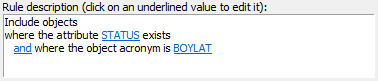
3. Repeat as necessary.
4. Click Next.
Conditions
This table contains a list of conditions and brief instructions on setting values for each condition.
Condition | Procedure |
Where attribute acronym exists. Where attribute acronym does not exist. | 1. Click the attribute acronym link. The Attribute Acronym dialog box is displayed.
2. Select an attribute acronym from the list. 3. Click OK. |
Where the attribute acronym is equal to value. Where the attribute acronym is not equal to value. Where the attribute acronym is less than value. Where the attribute acronym is less than or equal to value. Where the attribute acronym is greater than value. Where the attribute acronym is greater than or equal to value. | 1. Click the attribute acronym link. The Attribute Acronym dialog box is displayed.
2. Select an attribute acronym from the list. 3. Click OK. 4. Click the value link. The Attribute Value dialog box is displayed.
5. Select a value from the list. Values shown in the dialog box are determined by the selected attribute acronym. 6. Click OK. |
Where the attribute acronym contains value. Where the attribute acronym does not contain value. | 1. Click the acronym link. The Attribute Acronym dialog box is displayed.
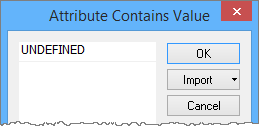
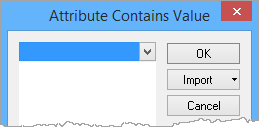
2. Select an attribute acronym from the list. 3. Click OK. 4. Click the contains/does not contain link to toggle from one to the other. 5. Click the value link. The Attribute Contains Value dialog box is displayed.
6. Enter or select an attribute value. 7. Click OK. |
Where the spatial attribute acronym is equal to value. Where the spatial attribute acronym is not equal to value. Where the spatial attribute acronym is less than value. Where the spatial attribute acronym is less than or equal to value. Where the spatial attribute acronym is greater than value. Where the spatial attribute acronym is greater than or equal to value. | 1. Click the acronym link. The Attribute Acronym dialog box is displayed.
2. Select an attribute acronym from the list. 3. Click OK. 4. Click the equal to link to select the appropriate operator. 5. Click the value link. The Attribute Contains Value dialog box is displayed.
6. Enter a value in the text entry field. 7. Click OK. |
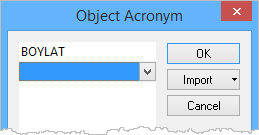
Where object acronym is acronym. Where object acronym is not acronym. | 1. Click the acronym link. The Object Acronym dialog box is displayed.
2. Select an object acronym from the list. 3. Click OK. |
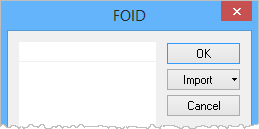
Where the feature ID is value. | 1. Click the value link. The FOID dialog box is displayed.
2. Type a value in the field. 3. Click OK. |
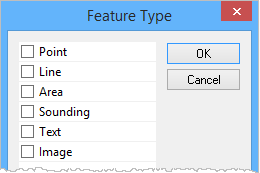
Where feature type is type. Where feature type is not type. | 1. Click the type link. The Feature Type dialog box is displayed.
2. Click a Feature Type check box so it is selected. 3. Click OK. |
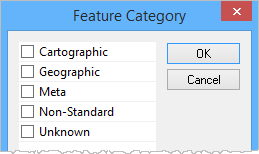
Where feature category is type. Where feature category is not type. | 1. Click the type link. The Feature Category dialog box is displayed.
2. Click a Feature Category check box so it is selected. 3. Click OK. |
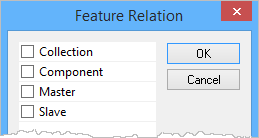
Where feature relation is relation. Where feature relation is not relation. | 1. Click the relation link. The Feature Relation dialog box is displayed.
2. Click a Feature Relation check box so it is selected. 3. Click OK. |
Where the area is smaller than value. Where the area is larger than value. | 1. Click the smaller than link to toggle between it and “larger than”. 2. Click the value link. The Value dialog box is displayed.
3. Type an area value. 4. Click OK. |
Where the width is thinner than value. Where the width is wider than value. | 1. Click the thinner than link to toggle between it and “wider than”. 2. Click the value link. The Value dialog box is displayed. 3. Type a width value. 4. Click OK. |
Where the length is shorter than value. Where the length is longer than value. | 1. Click the shorter than link to toggle between it and longer than. 2. Click the value link. The Value dialog box is displayed. 3. Type a length vaue. 4. Click OK. |
Where the perimeter is shorter than value. Where the perimeter is longer than value. | 1. Click the shorter than link to toggle between it and “longer than”. 2. Click the value link. The Value dialog box is displayed. 3. Type a perimeter value. 4. Click OK. |
Where the object is too small to enclose a sounding digit at a scale of value. | 1. Click the sounding digit link. The Sounding Digit dialog box is displayed.
2. Select a digit option. 3. Click OK. 4. Click the scale link. The Scale dialog box is displayed.
5. Type a scale value. 6. Click OK. |
Where the depth is equal to value. Where the depth is not equal to value. Where the depth is less than value. Where the depth is less than or equal to value. Where the depth is greater than value. Where the depth is greater than or equal to value. | 1. Click the equal to link to toggle between the operators. 2. Click the value link. The Depth dialog box is displayed.
3. Enter a value in the text entry field. 4. Click OK. |