Menu | File > Export > Coverages > ASCII |
Pop-up | coverage layer > Tools > Export to ASCII (Layers window) |
Export attribute information for a selected coverage to an ASCII text file. By default, the exported file will contain the position and selected attribute values for each node. Attribute values will be exported based on the settings for the Units options in Tools > Options.
Interface
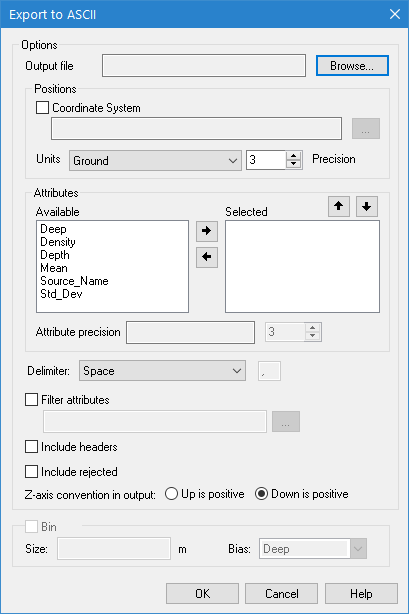
Export Coverage to ASCII uses the Export to ASCII dialog box.
Values entered in this dialog box that are not dependant on the current dataset (for example, Precision or Delimiter) will be remembered for future use. |
Option | Description |
Output File | The name and location for the resulting ASCII file. |
Coordinate System | On: The user must select the coordinate system to use for the export by clicking the browse (...) button, which launches the Select Coordinate Reference System dialog box, and selecting a coordinate system. See Coordinate Reference System Selection for information on using this tool. Off: Data is exported using the coordinate system of the source data. |
Units | The horizontal position units to use for position values. The position units options available will differ depending on the format of the source data. • If exporting Ground data, all options provided in the drop-down list will be available. • If exporting Geographic data, the Ground option will not be displayed. The drop-down list provides the following options: • Ground: ground units • Geographic DMS (N/S/E/W): geographic degrees-minutes-seconds. A cardinal direction character, N, S, E, or W, is appended to the end of each coordinate value for the hemisphere. • Geographic DMS: geographic degrees-minutes-seconds. A minus character ("-") is appended to the beginning of each coordinate value in the S or W hemisphere. • Geographic DD: geographic decimal-degrees. A minus character("-") is appended to the beginning of each coordinate value in the S or W hemisphere. |
Precision | The number of decimal places to include in coordinate values. Up to nine decimal places are allowed. |
Available | All attributes in the input coverage that are available for export. To include an attribute in the exported data, select the attribute in the Available list and click the right-arrow button to move it to the Selected list. |
Selected | The attributes of the input coverage that have been selected to be included in the export. The order of the attributes in this list control the order of the attributes in the output file. The order can be changed as needed using the up-arrow and down-arrow buttons when an attribute is selected in the list. Attributes can also be removed from the Selected list using the left‑arrow button. |
Attribute Precision | Assign a precision value to each attribute being exported. The precision determines the number of decimal places in the exported values. Select the attribute in the Selected list and select or type a precision value in the field. |
Delimiter | The character used to separate attribute values in the ASCII file. This character makes it easier to distinguish the exported values for each attribute. A space, comma, or tab are provided as options, but any single alphanumeric character can be used. |
Filter Attributes | On: Filter out data you do not want included in the export, for example, interpolated nodes. Filtering is performed according to attribute values using an equation built in the Filter Attributes dialog box, which is launched from the Filter attributes browse (...) button. See Filter Attributes for information on using the Filter Attributes dialog box. Off: All data is exported for the selected attributes. |
Include Headers | On: The first row of the ASCII file is populated with column headers for the selected attributes. Off: The first row of the ASCII file is populated with attribute values. |
Include Rejected | On: Include rejected soundings in the export. By default, soundings flagged as rejected are not included to ensure that a clean surface can be created from the exported data. Off: Rejected soundings are excluded from the export. |
Z-axis convention in output | Define the Z-axis convention of the data in the exported file. By default, the export will use the direction defined in the Z-axis Convention option in the Coverages category of Tools > Options, but this setting will override that setting. If the exported Z values are required to be Z-axis positive up, select Up is positive. If the exported Z values are required to be Z-axis positive down, select Down is positive. |
Bin | Nodes in the selected coverage can be exported as binned (each in its original position in the grid cell). Click the check box to enable the binning options. |
Size | If full resolution is not required for the data, a lower resolution size can be specified. |
Bias | Export the data with either a shoal or deep bias. |
The Bin options are only available if exporting with the BASE Editor licensed module. |
Procedure
1. In the Layers window, select the layer containing the data to be exported.
2. Select the Export Coverage to ASCII command.
The Export to ASCII dialog box is displayed.
3. Click the Output file Browse button (...) and specify a name and location for the ASCII file.
4. [Optional] Click the Coordinate System check box to export with a coordinate system other than that of the source data.
5. Click the Coordinate System browse (...) button to launch the Select Coordinate Reference System dialog box and select a coordinate system.
6. Select an option from the Units list.
7. Enter a value in the Precision field.
8. Select the attributes to be included in the output and define their order in the list.
If a colour band is selected for export, the colour values will always export as four separate columns and in the order red, green, blue, alpha. |
9. Specify the Attribute precision for each attribute in the Selected list.
10. Select the Delimiter to be used in the output file.
11. Select the Z-axis convention to use for the exported elevation values.
12. Complete any other optional settings as needed.
13. Click OK to perform the export.
The source data is exported to a new ASCII text file.
If the export includes nodes with no known value, they will be assigned a value like -99999.0, depending on the band type. This allows no-data nodes to be easily identified in the output. |
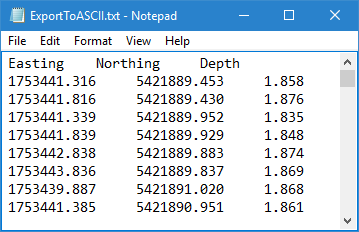
The resulting text file should look something like the image below.