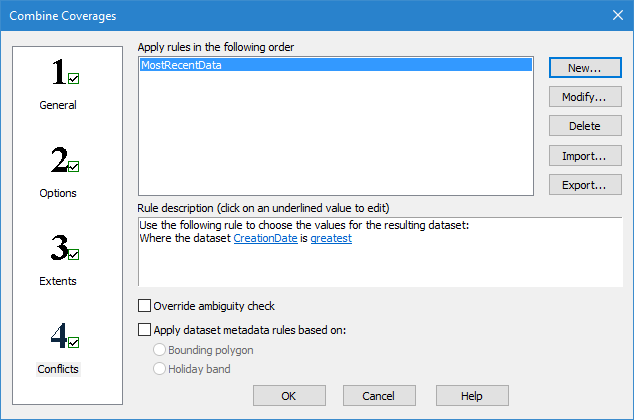
Step 4: Conflicts of the Combine Coverages wizard is used to define conflict resolution rules. These rules tell the application how to resolve conflicts between overlapping areas of the selected input coverages.
Conflicts can exist both within a single coverage and between overlapping coverages.
• Conflicts within a single coverage occur when multiple nodes exist at the location of a single grid node on the output coverage. For example, this can occur if the output coverage has a coarser resolution than the input.
• Conflicts between multiple coverages occur when areas of each coverage overlap.
Rules define which data supersedes other data in a conflict. If you have created rules in the current session, they are displayed in the Apply Rules... list. If you have existing rules that were not created in this session, they can be added to the list using the Import button. Otherwise you must create new rules. Any rules in this list are applied to all coverages included in the combine. See Conflict Rule Examples for some examples of rules.
Interface
The following is the fourth step of the Combine Coverages wizard.
Option | Description |
Apply rules in the following order | The conflict resolution rules to apply when combining coverages. This list is populated with all rules that have been created in the current session or imported. The rules are applied in the order that they are listed. The order can be changed by selecting a rule and dragging it to a new location in the list. |
Rule description | The details of the rule currently selected in the list of rules to apply. |
New | Launch the Rule Wizard and create a new conflict resolution rule. See Rule Wizard for information on creating and editing rules. |
Modify | Launch the Rule Wizard and edit the rule currently selected in the list of rules to apply. 1. Select a rule in the list. 2. Click Modify. 3. Edit the settings of the rule. 4. Click OK to save the changes and return to the Combine Coverages wizard. |
Delete | Remove the currently selected rule from the list of rules to apply. If the rule has not been exported to a file, the rule will be permanently deleted. If it has been saved to a file, this will simply remove the rule from the list; the rule file will not be affected. |
Import | Import an existing rule that has been previously exported to a rule file. |
Export | Export a new or edited rule to a new rule file for future use. This will create a .crfx file with the details of the rule. |
Override ambiguity check | Select this option if conflict resolution is not required. When this option is selected, the application will first use any conflict rules to try to resolve conflicts. If the conflict cannot be resolved, the application will then automatically select the first node that meets all the criteria in the rules. Whichever coverage contains this node will be considered the superseding coverage. |
Apply dataset metadata rules based on | This option can be used to consider holes as valid data in the combine process when applying metadata rules. This option requires the selection of at least one metadata rule. When this option is applied, the winning surface of a metadata rule will be determined based on the metadata only, regardless of whether the surface has populated data or holes in the area. Any holes within the winning areas will be preserved in the output surface. This option can be applied based on the source surfaces’ bounding polygon or holiday band. • When using the Bounding polygon option: • The entire area inside the bounding polygon of the winning surface will contribute to the output surface, whether it is populated with data or not. See Digitize New Bounding Polygon for information on creating or editing bounding polygons. • If conflicts cannot be resolved using a single rule, multiple rules can be applied, but they must be metadata rules - band level rules cannot be applied when using this option. • When using the Holiday band option: • The entire area covered by the holiday band of the winning surface will contribute to the output surface, whether it is populated with data or holes. • Areas outside the data are not considered; only internal holes identified by a holiday band may be preserved. • A holiday band must already exist for each surface being combined. A holiday band classifies each pixel of a surface as no data, data or a hole. This classification defines which areas are holes in a surface, which areas contain data and which areas are outside of the surface area. See Identify Holidays for information on creating a holiday band. • If conflicts cannot be resolved using only metadata rules, band-level rules can also be applied. Hole-preservation cannot be guaranteed in this case. Alternatively, the override ambiguity option can be enabled. If combining only point clouds and rules have been specified, the Bounding polygon option needs to be selected. The Holiday band option is not applicable in this situation. 1. Click the check box to enable the options. 2. Select an option. |
Procedure
1. Create or import conflict resolution rules.
2. Export the rule if it is to be kept for future use.
3. Enable any other necessary options.
4. Click OK.
The time required to complete this process will vary based on the number of coverages and their respective sizes.
When the process is successful, a coverage is generated and a message indicating the start and end times of the process is displayed in the Output window. If the coverages combined did not have the same vertical reference system, the message will include that fact and inform the user that the selected reference system was used. If a database was selected for the output location, the new database object and coverage are saved to the database.
The resulting coverage is added to the Layers window and the Display window. The coverage will contain all bands that were present in the source coverages. If the input coverages contained incompatible bands (attributes with the same name but different Z-axis directions or different data types), those bands will not be included in the output coverage. Any bands that were skipped will be identified as soon as the combine operation is started. For a local combine, this will be reported in the Output window. For a database combine, this will be recorded in the log files for the database.
The Designated band will only be included if designated soundings/nodes were selected during conflict resolution. |
If the combine is not successful due to unresolved conflicts, the following error message is displayed and the Combine Coverages wizard remains open.
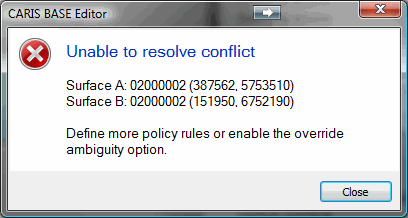
The combine process will not complete successfully if the rules defined did not resolve all conflicts. For example, if a procedure used MostRecentData but both coverages had the same date, the conflict would not be resolved.
If it is important that all conflicts be resolved before creating the output coverage, additional rules are required and you can then try again.