Menu | Database > Set Coverage |
The Set Coverage command is used to associate a coverage to an existing database object. This can be done to add a coverage to an object that is not currently associated with any data, or to replace the coverage to which an object is already associated.
Because this operation will add data to a database, and this cannot be undone via the Undo command, the application will not allow this command to be run if there are any previous unsaved changes. If there are any unsaved changes, a message will be displayed prompting you to save your changes before continuing.
Related commands:
Interface
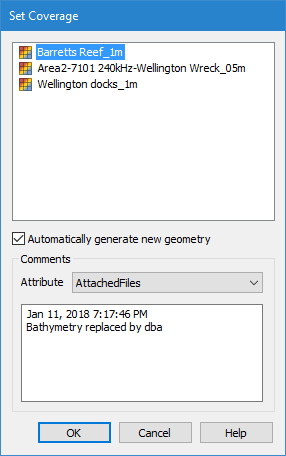
The Set Coverage command uses the following dialog box.
Option | Description |
Coverage list | The coverage to be associated with the selected database object. All currently open coverages are listed as available sources, including coverages opened locally from other database objects. |
Automatically generate new geometry | Automatically recreate the geometry of the database object that is being associated with the coverage according to the coverage extents. This option is enabled by default. |
Comments | Add a comment to the coverage as an attribute value explaining the replacement/addition of the data. The comment can added to any text-entry type attribute present in the catalogue of the database. The default comment text includes: • the date and time that the bathymetry was replaced/added • a statement that the bathymetry was replaced/added • the user that performed the action 1. Select the Attribute to be populated with the comment. 2. Edit or add text to the comment field as needed. |
Procedure
1. Open the relevant coverage.
2. Select a database filter layer in the Layers window.
3. Select the database object that you want to have associated with the coverage
4. Select the Set Coverage command.
The Set Coverage dialog box is displayed.
5. Select a coverage from the list.
6. [Optional] Click the check box to turn on/off the automatic regeneration of the database object.
7. [Optional] Add a comment for the change.
8. Click OK.
The selected coverage is associated with the active database object.