Menu | Edit > Contours > Smooth Contours |
Smooth existing line and area features using a safe-side direction-biased method. Smoothing reduces the number of vertices in a feature, improving the efficiency of processing these features.
The safe-side smoothing method allows a selection of contours and their related depth areas to be smoothed at the same time. If an appropriate bias is used, it is guaranteed to shift vertices to the deep side of a sloped feature, producing hydrographically safe results.
Smoothing is applied in multiple iterations, shifting points each time to minimize curvature in the lines. Points are shifted in the direction that best keeps the line to one side of its initial state. The direction is determined using contour metadata and user-specified settings.
The results of the smoothing can be reversed using the Undo command, if needed.
It is recommended that this command be used on contours generated with the Bathy DataBASE catalogue as only those line features can contain a contour slope attribute. |
Interface
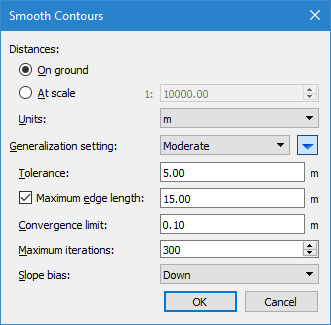
The Smooth Contours command uses the following dialog box.
Option | Description |
Distances | The type of measurement to use for distance values. This can be distance on the ground, or distance at map scale. If using At scale, you must specify the scale to use. 1. Select a distance option. 2. If using the At scale option, either use the Up and Down arrow buttons to select a scale value or click in the field and enter a value. |
Units | The unit of measure for distance values. The default setting is controlled by the Ground Units setting under Distance in the Units category of Tools > Options. Changing this setting will automatically convert any values populated in other fields in the dialog box. If a different option is selected from the drop-down list, this selection will be remembered the next time the process is run. |
Generalization setting | The level of smoothing to be applied. There are four levels available, each with a set of default values. These values can be seen by clicking the blue arrow button |
Tolerance | The minimum distance allowed between points. Points within the tolerance of each other will be collapsed together so that curves too small to see will be treated as sharp angles. Safe-side correction will overcompensate by moving unsafe components to be half the tolerance distance from the original contour on the safe side of the line. Note that an unscaled tolerance of 1m will be identical to a scale of 1:1000 and a tolerance of 1mm. |
Maximum edge length | The maximum edge length of a feature. Edges longer than this will be subdivided to create multiple smaller edges. It is recommend that edges be no more than 5 times the tolerance value. 1. Click the check box to enable this option if it is not already enabled. 2. Enter an edge length value. |
Convergence limit | The minimum distance by which at least one point must be moved in a single iteration of the process in order for subsequent iterations to be run. If no points are moved at least the specified distance, the process will stop, regardless of the Maximum Iterations setting. |
Maximum iterations | The maximum number of smoothing iterations to be performed for a single run of the process. Once this number of iterations have been run, the process will stop, regardless of the Convergence Limit setting. |
Slope bias | This option is used to define the direction bias of smoothing for contours that have a populated contour slope (cntdir) attribute, which is only available if the contours were generated using the Bathy DataBASE catalogue. For hydrographic purposes, Down guarantees a hydrographically safe result and is the default value. This setting should only be changed for specific tests or if smoothing towards higher elevation is explicitly desired. This option is only displayed if some of the selected contours do not have a populated contour slope attribute value. |
Direction bias | This option is used to define the direction bias of smoothing for contours that do not have a populated contour slope attribute. For contours generated in CARIS applications, Right is usually the safe direction, however it is best to confirm that against the source dataset for which the contours were generated. Deep isolations and contours generated outside CARIS may have a reversed contour direction, which could require that LEFT be used to preserve safety. The IGNORE option can be used to apply smoothing only to contours that have populated slope attributes. This option is only displayed if none of the selected contours have a populated contour slope attribute value. |
Examples
Below are examples showing the results of applying each smoothing level to the same set of data, using the default values defined for the levels. The original contour lines are shown in black and the smoothed contours in colour.
• Minimal: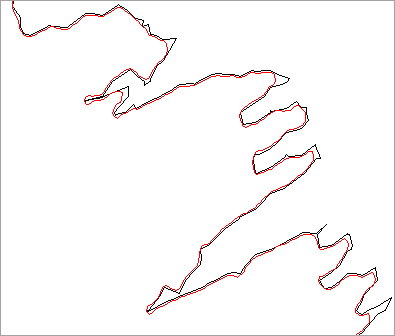
• Detailed: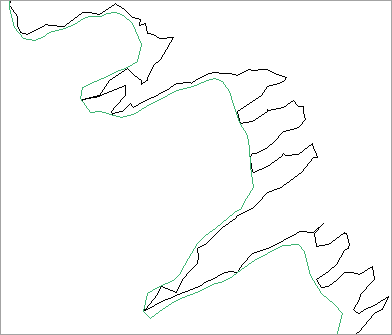
• Moderate: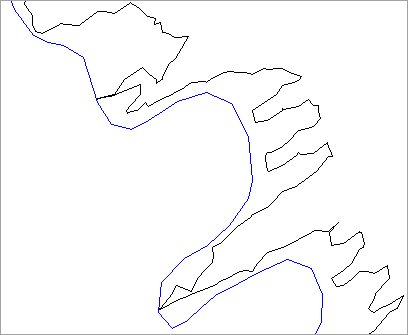
• Broad: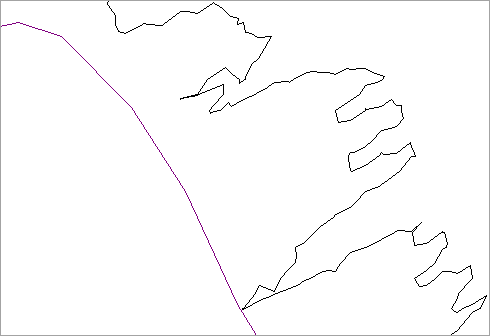
Procedure
1. Select a feature layer with contours.
2. Select one or more contour lines.
3. Select the Smooth Contours command.
4. Select the type of distance values to use.
5. Select the unit of measure for the distance values.
6. Select the level of smoothing to apply from the Generalization setting drop-down list.
If Custom was selected for Generalization setting, continue to the next step. Otherwise, go to the last step.
7. Click the blue arrow button to expand the dialog box and view the additional fields.
8. Enter a value for the Tolerance distance.
9. [Optional] Click the check box to enable the Maximum edge length option and enter a size value.
10. Enter a value for the Convergence Limit.
11. Select the maximum number of iterations to be run.
12. Select the Direction Bias with which to move points.
13. Click OK.
The selected contours and depths areas are smoothed according to the settings defined.
 to expand the dialog box. A