Menu | Tools > Coverages > Extract > Using Feature Layer |
The Extract Using Feature Layer command is used to create a new surface by copying one or more sections of an existing surface. The sections to be copied are identified by coverage area (cvrage) features in a feature layer associated with the data. This feature type is available when using the Bathy DataBASE catalogue and can be boundary type or hole type. Boundary type suggests that there is data in the area. Hole type suggests that there is no data in the area, or that the data in the area of the hole is not valid.
The copied sections will be saved as new surfaces, using the attribute values you selected from the existing surface. All attributes present in the source surface can be selected to be included in the new surface. The resulting surfaces will include the extents of each coverage area in the feature layer, including disjointed areas. If there are any hole type coverage areas, they will be reflected in the new surfaces.
You can use an existing feature layer and objects, or create a new layer and cvrage objects specifically for the extraction. See Create Feature Layer, Create and Digitize for information on creating a new layer and objects.
You may choose to use filters to extract only specific data from the designated sections of the source surface. When applying a filter, you set conditions for the filter and only the nodes within the selected areas that meet the conditions will be extracted.
Related commands:
• Extract Surface: By Digitizing
Interface
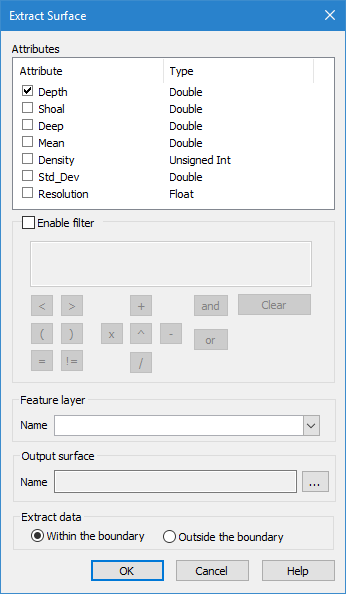
The Extract Surface Using Feature Layer command uses the following dialog box.
Option | Description |
Attributes | A list of all bands present in the source surface and the type of data contained in the bands. Click the check box of each attribute to be included in the extracted surface. The primary Z band (Depth, Height, etc.) is mandatory and cannot be turned off. Also, any designated points within the selected area will automatically be included in the extraction. |
Enable Filter | Click to enable the filter controls if you want to apply a filter to the data being extracted using a boolean expression. See Filter Expressions for more information on using filters. |
Filter Equation Field | Use the filter controls and the keyboard to enter a filter equation in the field. For example, if you only want nodes with a Depth value of less than 8 metres, you would: • Double-click Depth in the Available Attributes list to add it to the filter. • Use the keyboard and/or filter buttons to add " < 8" after the attribute (including the spaces). The resulting filter displayed in the field will be "Depth < 8". |
Feature Layer Name | The feature layer containing the cvrage objects identifying the sections of the surface to be extracted. This field is populated with all feature layers currently open in the application. |
Output Surface Name | The name and location for the extracted surface. |
Extract Data | The Extract data option is used to identify whether to extract data from within the feature object or data outside of the feature object. If you were to select Within the boundary, only data within the digitized line would be extracted. If you were to select Outside the boundary, only data outside the digitized line would be extracted, resulting in a surface with a hole in it. |
Procedure
1. Open a feature layer containing cvrage features, or create a feature layer and add cvrage features.
2. Select a raster surface or point cloud in the Layers window.
3. Select the (Extract) Using Feature Layer command.
The Extract Surface dialog box is displayed.
4. Click the check boxes of the Attributes you want to include in the extracted surface.
5. [Optional] Enable the filter options and enter a filter equation.
6. Select the Feature layer containing the cvrage features you want to use to define the extents of the extraction.
7. Click the Output surface browse button (...) then define a name and location for the extracted surface.
8. Select an Extract data option.
9. Click OK.
The data covered by the feature objects is extracted to a new surface