Menu | Tools > Coverages > Interpolate Surface |
Tool |
|
Pop-up | TIN band > Interpolate Surface from TIN (Layers window) |
Menu | Tools > Coverages > Interpolate Surface |
Tool |
|
Pop-up | TIN band > Interpolate Surface from TIN (Layers window) |
Create a raster surface by interpolating a TIN or a variable resolution surface.
There are two interpolation algorithms to choose from:
• Linear: This method uses a weighted sum of its natural neighbour's elevations to calculate the slopes of a surface. Depth is then computed based on the elevation on the slope at the location of each node. Two points are natural neighbours if their areas border one another. Linear interpolation has shorter processing times, but produces slightly coarser surfaces.
• Natural Neighbour: This method first calculates the slopes of a surface using the linear method, then applies an algorithm that determines the slope value for each specific data point in the dataset. This value is determined by calculating the effect of removing a point from the surface and then blending that data into the surface. The depth is computed using a weighted average of each point's expected neighbours and the trend of the slopes at these neighbours. Natural Neighbour interpolation has longer processing times, but produces smoother surfaces.
Each cell in the surface is checked to determine if one or more original sounding values are present within the area of the cell.
• If an original value is not present, an interpolated value is used.
• If an original value is present, the shoalest value with true position is used.
You can also select an uncertainty source attribute (for example, Std_Dev) to use for modelling the surface.
• If the Uncertainty option is selected, when the raster surface is generated, any cells that contain interpolated values will also be populated on the Uncertainty band with an interpolated value.
• If the Uncertainty option is not selected, the Uncertainty band in the resulting surface would only have cells populated where the Depth band was populated in the source dataset.
Related commands:
• New Variable Resolution Surface
Interface
The Interpolate Surface command uses the following dialog box.
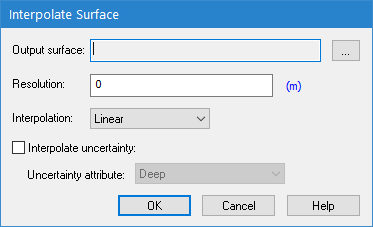
Option | Description |
Output surface | The name and location for the resulting surface. |
Resolution | The resolution of the data in the output surface, which controls the spacing of the nodes in the surface. Both a value and a unit of measure must be specified for the resolution. The unit of measure defaults to the Ground Units setting in the Units category under Display in Tools > Options. When entering the resolution value, ensure that the precision of the value is within the precision defined for Geographic Distance Along Axis in the Coverage category in Tools > Options. If you enter a resolution value that is too precise, a message will be displayed asking you to enter a valid resolution. For example, the default value for Precision is 6. If you enter a resolution with more than 6 decimal places, the interpolation cannot be performed. 1. Type a value in the Resolution field. 2. Click the unit of measure hyperlink to select the desired units. The smaller the resolution value, the greater the disk space required for the surface. |
Interpolation | The type of interpolation to apply to the source data to create the new surface. |
Interpolate uncertainty | Select this option to include an uncertainty attribute in the interpolated data. |
Uncertainty attribute | The attribute in the source surface to be used as the uncertainty source. The drop‑down list includes all bands present in the source surface. |
Procedure
1. In the Layers window, select the TIN or variable resolution surface to be interpolated.
2. Select the Interpolate Surface command.
The Interpolate Surface dialog box is displayed.
3. Click the browse button (...) and define a name and location for the Output surface.
4. Define the Resolution for the output.
5. Select the Interpolation method to be applied.
6. Define any other necessary options.
7. Click OK.
If you entered a Resolution value that is significantly smaller than the mean edge length value in the source dataset, the following message is displayed.
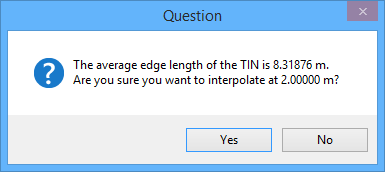
8. To confirm the resolution value you typed is the one you want to use to interpolate the output surface, click Yes. To enter a new resolution value, click No and return to the dialog box.
A progress indicator is displayed on the left side of the status bar while the new surface is created. When finished, the surface is displayed in the Layers window. This surface will include an Interpolated band to represent the values from the original data source from which the TIN or variable resolution surface was created. If you chose the Uncertainty option, an Uncertainty band is also included.
