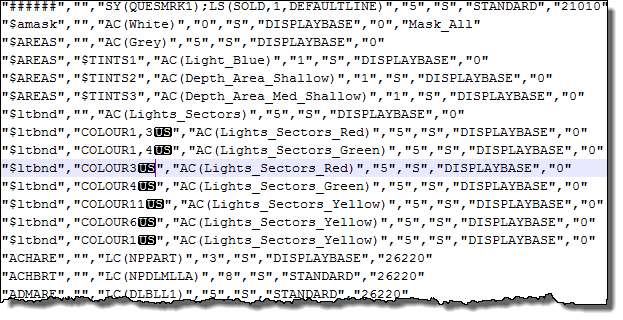
Lookup tables define symbology for INT1, S-52 and VPF portrayals. All files are in text format and have a .dic file extension.
The following table lists portrayals and associated lookup tables.
Portrayal | Lookup Tables |
S-52 Simplified | areas: lines: points: |
S-52 Traditional | areas: lines: points: |
IENC Simplified | areas: lines: points: |
IENC Traditional | areas: lines: points: |
IENC Simplified-Brazil | areas: lines: points: |
IENC Traditional-Brazil | areas: lines: points: |
IENC Simplified-Paraguay-Parana Waterway | areas: lines: points: |
IENC Traditional-Paraguay-Parana Waterway | areas: lines: points: |
VPF | areas: lines: points: |
INT1 | areas: lines: points: text: |
All lookup file entries use the same structure: a row starting with a feature acronym and followed by six other fields – each field is separated by a comma and enclosed in quotation marks.
All lookup tables contain non-printing unit separator characters. These cannot be removed without corrupting the table. Lookup tables should be modified in a text editor capable of displaying non-printing characters. |
The first four fields are used for displaying data.
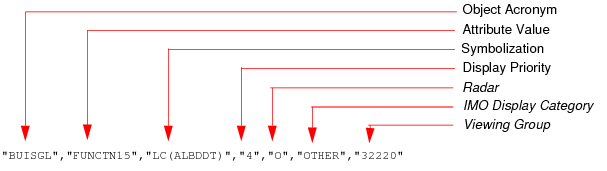
Features are drawn in the chart by matching feature type to the appropriate lookup table. For example, an INT1 area feature is located in asymrefs.dic.
The following sections describe how CARIS reads the four fields.
Object Acronym
The Object Acronym field has the following characteristics:
• six-character object acronym
• features are listed in alphabetical order
• all entries for a single feature code are grouped together
• specific entries are listed before more general entries
• if no feature acronym is found, the first entry is used to draw the feature
Attribute Value
The Attribute Value field has the following characteristics:
• six-character attribute acronym
• attributes are listed in the following format<attribute_acronym><value><separator>
• if the attribute is defined, the object must contain the attribute
• if the attribute value is marked with ?, then the value is set to UNKNOWN
• matching attribute values must be of integer or float type—string attributes are not matched
• specific attribute entries are listed before more general entries
When a lookup table has been selected, CARIS checks the table to find the acronym and attributes corresponding to the feature. This means that the first entry in the lookup table whose attributes matches the feature will be chosen. If there is more than one entry for an acronym, the first match is used.
For example, if the dataset contains an ACHARE (Anchorage area) feature with a Category of Anchorage (CATACH) attribute with a value of 2, the third entry for the ACHARE feature acronym, CATACH2, is used.
If the ACHARE feature contains no attribute values, or contains attribute values not listed in the lookup table, the first entry is used.
"ACHARE","","LC(NPPART)","3","S","DISPLAYBASE","26220" |
"ACHARE","CATACH1OBJNAM","LC(NPPART);SY(NPAN)","3","S","DISPLAYBASE","26220" |
"ACHARE","CATACH2","LC(NPPART);SY(DLAN)","3","S","DISPLAYBASE","26220" |
"ACHARE","CATACH3","LC(NPPART);SY(DLAN)","3","S","DISPLAYBASE","26220" |
"ACHARE","CATACH4","LC(NPANSY);SY(DLAN);SY(IN12)","3","S","DISPLAYBASE","26220" |
"ACHARE","CATACH5","LC(NPPART);SY(DLAN);SY(NPALHO)","3","S","DISPLAYBASE","26220" |
"ACHARE","CATACH9","LC(NPPART);SY(DLAN)","3","S","DISPLAYBASE","26220" |
"ACHARE","STATUS6","LC(NPPART);SY(DLAN)","3","S","DISPLAYBASE","26220" |
In another example a soundings feature code is not specified for the following entry:
"SOUNDG","","CS(SOUNDG02)","6","O","OTHER","33010" |
You can add the SGSL1 soundings feature code to the entry:
"SOUNDG","","CS(SOUNDG02,,SGSL1)","6","O","OTHER","33010" |
SGSL1 will be used for all SOUNDG features.
Symbolization
The Symbolization field has the following characteristics:
• symbology entries are separated by semi-colons;
• entries are placed in the order given in the lookup table;
• area colour fills are listed before lines or centred symbols; and,
• features drawn with no specific symbolization use double quotation marks ("").
The following table lists the feature type and relevant symbolization codes.
Feature Type | Symbology Instruction | Comments |
Points |
(S-52 only) | This code is a call to a conditional symbology procedure, used only for drawing soundings type point features. Note: DEPTH_ATTRIBUTE and FEATURE_CODE are parameters of the SOUNDG02 procedure. SOUNDG02: the conditional symbology procedure used to display depth values for point objects. As a procedure call, this parameter is a literal value which must be included in the instruction as SOUNDG02. DEPTH_ATTRIBUTE: the sounding feature attribute from which the sounding value is retrieved (for example, VALSOU). FEATURE_CODE: the feature code used (for example, SGSL). |
(paper charts only) | This code is used for drawing a symbol using the specified feature code in the ih_master.txt file. If the feature code does not exist in the master file or in invalid for symbols, a ? character is used instead. | |
(paper charts only) | This code is similar to the above, except that it can assign an angular distance measured from true north (north azimuth). This can be the value of the attribute (typically ORIENT) or an explicit number. | |
Points (cont’d) |
(S-52 only) | The The
|
Lines |
(paper charts only) | This code draws a complex line using the feature code specified in the ih_master file. Line ends are drawn as retangular or rounded, according to the feature code in ih_master.txt. If the feature code does not specify a line-end style, rectangular is used as the default. If the $capsy (cap style) attribute for the line feature is set, this value overrides the feature code settings in ih_master.txt. If the feature code does not exist in the master file or in invalid for symbols, a ? character is used instead. The LC code is the preferred code for line drawing. |
(paper charts only) | This code draws a line. The first parameter can be The second parameter is the width of the line (in pixels). The third parameter is the colour token. If the $capsy (cap style) attribute for the line feature is set, this value overrides the settings in line lookup table. The default line end is rectangular. | |
(S-52 only) | This code draws a line using a feature code specified in LIN (.lin) file in symshow folder. If the $capsy (cap style) attribute for the line feature is set, this value overrides the feature code settings. | |
(S-52 only) | This code draws a line. The first parameter can be The second parameter is the width of the line (in pixels). The third parameter is the colour token. The default line end is rounded. | |
(S-52 only) | This code is used for drawing a symbol in the middle of a line. This is the same code as used for point symbolization. See the Points section for more information. | |
Areas |
(S-52 and paper charts) | This code specifies the colour token name from |
(S-52 and paper charts) | The second parameter is used to define transparency (1=25%, 2=50%, 3=75%). This feature is not yet supported: only solid colours are drawn. | |
(paper charts only) | The • • • • • • The default value is The third parameter sets the thickness of the hatch lines. The default value is 0.01 mm. The fourth parameter sets the spacing between the hatch lines. The default value is 1.0 mm. | |
(paper charts only) | The pattern fill name used to reference pattern fill definitions (not yet supported). | |
(paper charts only) | For definitions, see the Lines type section. | |
(paper charts only) | For definitions, see the Lines type section. | |
(paper charts only) | For definitions, see the Points type section. | |
Text |
(paper charts only) | Draw a text box around the text feature.
|
(paper charts only) | Draw a halo around each character of the text feature. The first parameter is the colour token. The second parameter is the width of the halo line around each text character. The halos are drawn underneath the characters of the text. | |
(paper charts only) | Draw a symbol behind the text feature.
|
Display Priority
The Priority value controls the drawing order of objects. Features are drawn in numerical order, so features with a priority of one are drawn first and then the higher priority features are drawn on top of these features. You can override the default priority levels set in this file using the $prior attribute.