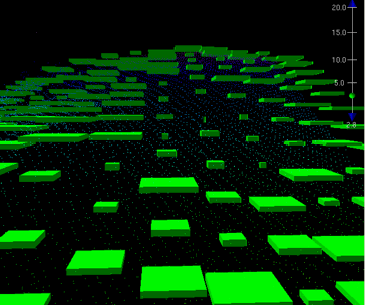
Below is an example of an enlarged section of a CUBE surface loaded in the 3D View.
Hypotheses are represented as squares. The squares have different dimensions to reflect the confidence level given to each hypothesis. These confidence levels range from 0.0 (the highest value) to 5.0 (the lowest value). The size of a square is related to the numerical confidence level: large squares represent nodes with the high confidence values while smaller squares represent nodes with low confidence values.
The thickness of the square represents the vertical uncertainty assigned a node (to a 95% confidence interval). The thicker the square, the greater the vertical uncertainty.
More than one hypothesis or a low confidence value does not necessarily mean an error. Uneven areas (slopes, for example) show more than one hypothesis because of the changing terrain.