Menu | Tools > Engineering Analysis > Shoals > Edit Record Association File |
Tool |
|
The Edit Record Associations File command is used to edit the SRA file that controls the interaction between EAM and the shoal database. This file must be set up appropriately to enable EAM to read data from and write data to the database. This file is selected during many shoal procedures, so it is possible to have multiple SRA files with settings relevant to different procedures. A sample SRA file, shoal_record_associations.sra, is provided with BASE Editor and is found at:
C:\ProgramData\CARIS\BASE Editor\<version>\SampleData\
You can make edits to this file, or you can save the file with a new file name and then make changes to that file.
To use the sample SRA, you must first install the sample data available from the CARIS Online Customer Services Web site under the Bathy DataBASE Suite page. You must be logged into the Customer Services Web site to access this page. If you do not have the sample data, an appropriate SRA must be setup to reference the shoal database that you intend to use.
Note that win32 applications can only access win32 ODBC data sources, and x64 applications can only access x64 data sources, so you must make sure that you register the data source appropriately. |
Menu | Tools > Engineering Analysis > Shoals > Edit Record Association File |
Tool |
|
To edit an SRA file:
1. Select the Edit Record Association File command.
The Edit Record Association File dialog box is displayed.
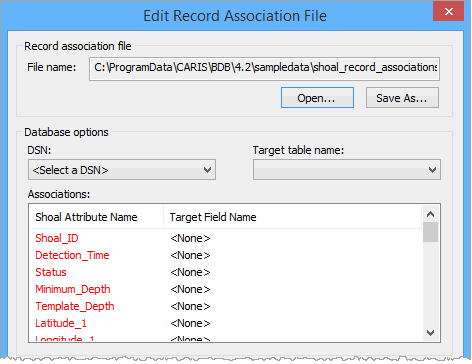
If the dialog box for this command opens without an error message being displayed—while it is referencing the |
The sample file is selected by default the first time the dialog box is opened. If you open another file, this file will be remembered the next time the dialog box is opened.
2. Click Open to select a different SRA file.
OR
Click Save As to save the file with a different name, creating a new file.
The fields in the Database options section allow you to define the database that will be used when this SRA file is selected. The DSN list is populated with any ODBC data sources that you have created for databases. If you do not have an ODBC data source for shoal data, one should be created. This is done by creating a database (if one does not exist) and a DSN source using the ODBC Data Source Administrator. See the Windows® documentation for your operating system for more information on using this tool.
When creating the database and data source, you must ensure that it will support the proper number of each data type, based on the mandatory Shoal Attributes. These attributes are displayed in red in the Shoal Attribute Name list.
3. Select a DSN option from the list.
4. Select a Target table name option from the list.
Depending on the target table selected, the Association table may or may not have attributes associated with fields. In this table you can assign the shoal attributes to fields names.
Each attribute has a data type (string, integer, etc.) and only the database fields of the same type can be associated to the attribute. Any fields with a different type will not be available for selection (grey and not selectable). Also, if a target field name has already been assigned to another attribute, it is not available for a second attribute. The mandatory (red) attributes must be defined.
5. Select a Shoal Attribute Name from the list.
6. For the selected attribute, select a Target Field Name using one of the following methods:
• To associate an existing field to the selected attribute, select it from the list and go to step 7.
• To associate no value to the selected attribute, select the None option from the list and go to step 7.
• To create a new field to associate to the selected attribute, select the Add a field option and continue with step i (the next step).
The Create Field dialog box is displayed.
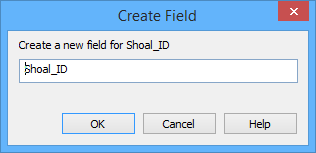
7. Type a field name.
8. Click OK.
The new field option is added to the list.
9. [Optional] For each field to associate with an attribute, repeat steps 5 and 6.
Next you need to define settings for the shoal database.
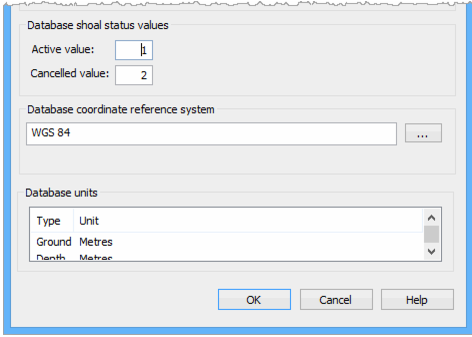
Using the Active value and Cancelled value fields, you can define the numbers that will be used to represent a shoal’s status when registered to the database. This status is reported in the Attributes window as the shlsta attribute.
10. Enter values in the Active value and Cancelled value fields.
The database selected in the SRA file needs to have a coordinate system assigned to it to ensure shoals are displayed in the correct location. To assign a coordinate system, you need to select a group and a description (zone).
11. Select a Group option from the list.
12. Select a Description option from the list.
You also need to define the unit of measure that should be used for the values of the shoals.
13. Select an option from the Ground units list.
14. Select an option from the Depth units list.
15. To finish editing the associations, click OK.
If you made changes to any associations without saving them, the following message is displayed.

16. Select one of the following options:
• To exit and save your changes, click Yes.
• To exit without saving your changes, click No.
• To continue editing, click Cancel.
If you chose to save, the shoal record associations file is updated.
