Menu | Tools > Surfaces > Fill Raster Holidays > Entire Dataset |
Tool |
|
Pop-up | surface > Fill Raster Holidays (Layers window) |
Menu | Tools > Surfaces > Fill Raster Holidays > Entire Dataset |
Tool |
|
Pop-up | surface > Fill Raster Holidays (Layers window) |
Fill empty nodes in a grid using values from surrounding populated nodes.
The Fill Raster Holidays for Entire Dataset command attempts to fill all holes in a selected coverage. The process begins by classifying all nodes in the coverage as data, holes, or no-data (areas beyond the coverage data but within the extents of the coverage). The classifications are used to determine the locations of holes that need to be interpolated. The application then analyzes the populated nodes surrounding holes to determine if there are enough neighbouring values to interpolate values for the holes based on user-specified criteria. If sufficient data is present, the process runs as a single iteration, filling all holes. Holes are filled as much as possible from the outer edge to the centre, given the populated data and specified criteria.
Large holes may be only partially filled as there may not be sufficient neighbouring data to completely fill a hole. The command can be run multiple times, however, to continue to fill holes using a single iteration each time. Each successive run will use the interpolated values from the previous run as populated neighbouring nodes.
The original coverage is not affected by this command. A new coverage is created and the classification and interpolation is performed on that data. The new coverage will be in the format of the input data. For example, if the source coverage is a raster grid, the output coverage will also be a raster grid. If the input were a point cloud, the output would be a point cloud. The new coverage will contain a copy of each attribute band that was selected for inclusion in the output as well as a Holidays band and an Interpolated band. The Holidays and Interpolated bands will contain the data classifications and the interpolated nodes. The names of these bands will differ depending on the name of the primary elevation band in the source coverage. For example, if the primary elevation band were called Depth, the interpolated coverage would contain a Depth and Holidays band and a Depth Interpolated band.
The Interpolated band can be used with filtering tools to filter out interpolated data when performing other tasks (for example, extracting a surface), if desired.
Related commands:
• Fill Raster Holidays By Range
• Fill Raster Holidays By Pointing
Interface
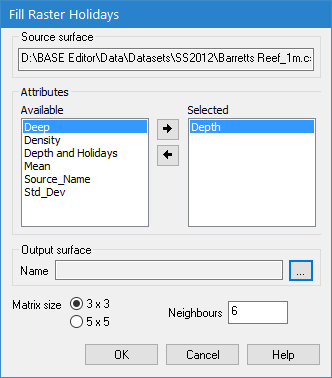
The Fill Raster Holidays command uses the following dialog box.
Option | Description |
Source surface | The Source surface is the coverage that contains the data to be interpolated. This field is defined by the coverage that was selected at the time the command was initiated and cannot be changed. |
Attributes | The attribute bands to be copied to the output coverage. The Available list contains all attributes present in the source coverage that are available for inclusion in the output. The Selected list contains all attributes that have been selected for inclusion in the output. The primary elevation band is selected by default and cannot be removed as it is the only band that is interpolated. All other attributes in the Selected list will be included in the output, but they will not be interpolated. To select attribute bands: 1. Select an attribute band in the Available list. 2. Click the right-arrow button to move the attribute to the Selected list. |
Output surface | The name and location for the output coverage. 1. Click browse (...) to open a Save As dialog box. 2. Enter a name and select a location for the output. |
Matrix size | The number of nodes surrounding a hole that will be analyzed for populated values. The options are 3x3 or 5x5, meaning the application will analyze a square area around each pixel of the hole that is either 3 pixels high and 3 pixels wide, or 5 pixels high and 5 pixels wide. |
Neighbours | The number of pixels within the matrix area that must contain data in order for the hole to be interpolated. For example, if you select the 3x3 matrix size option and enter a neighbours value of 6, that area must have at least 6 populated data nodes in order for a pixel in the hole to be interpolated. If there are not enough populated nodes present in the matrix area, it is possible that only some pixels in the hole will be interpolated or the hole will be skipped entirely by the process. |
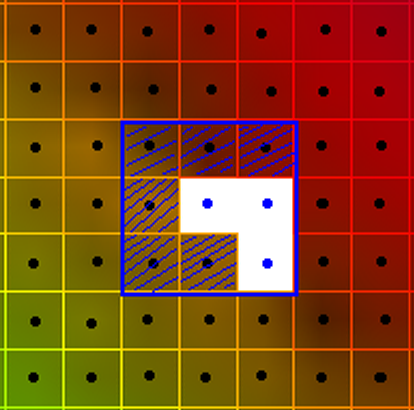
In the image below, the blue square represents a 3x3 matrix area. Each dot within the square is a node. Of those nodes, only the 6 shaded nodes contain data.
If the Neighbours field is defined as 6 or less, this would be sufficient to interpolate the pixel at the centre of the square. If the square were shifted to centre on each pixel in the hole, you can see the entire hole could be interpolated using the specified criteria.
Procedure
1. In the Layers window, select the root layer of the coverage to be filled.
2. Select the Fill Raster Holidays for Entire Dataset command.
The Fill Raster Holidays dialog box is displayed.
3. Select the Attributes to be included in the output.
4. Define a name and location for the Output surface.
5. Select a Matrix size option.
6. Type a value in the Neighbours field.
7. Click OK.
A new coverage is created and the holes in the data are filled as much as possible using the specified criteria and the available source data.
