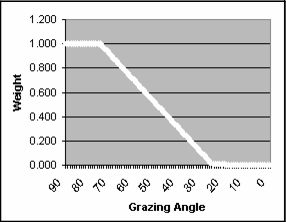
The weight a sounding contributes to the surface varies with the grazing angle of the sounding with the seabed.
This weighting value is important in areas with adjacent or overlapping track lines. The swath angle weight ensures that higher weight is given to beams from the inner part of a swath than to outer beams from adjacent track lines.
In this graph, beams with a grazing angle between 90 and 75 degrees are given a weight of 1.0. The weight decreases linearly to 0.01 as the angle with the sea floor decreases to
15 degrees.
This is the default swath angle weight scheme as defined by the GrazingAngleWeights.txt file in C:\ Program Files\CARIS\HIPS\<version>\System. To use another weighting scheme, customize this file.
Range weighting
Range weighting is used in creating Swath Angle and Uncertainty surfaces to determine how a sounding value is applied to a node.
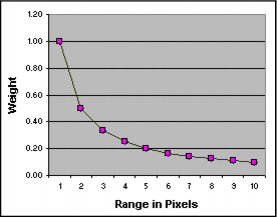
The range weight is inversely proportional to distance from the node: soundings closer to a node are given a greater weight than soundings further away. The calculated node positions are determined using the lower left corner of the area defined in the create Surface Wizard.
The number of nodes each sounding is applied to is determined by the size of the beam footprint. The beam footprint is calculated using depth, sonar beam width, and the grazing angle.
The sonar that is used, with the appropriate beam width, is defined in the Surface wizard.
A list of multibeam systems and corresponding beam widths is listed in C:\ Program Files\CARIS\HIPS\<version>\DeviceModels.xml.
The following graph demonstrates range weighting using distance from a node in units of pixels (multiples of the surface resolution).