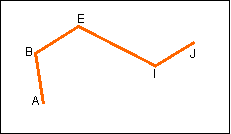
The Reumann-Witkam algorithm defines a strip as follows:
• The centre line of the strip follows a segment of the original line, defined by two points.
• The width of the strip is defined by the tolerance, which is defined as a distance perpendicular to the line segment being tested.
• The length of the strip can vary, depending on the angle of the line.
In this example, a strip follows line segment AB.
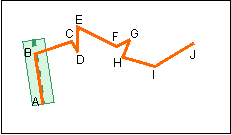
Note that the strip starts at point A but extends beyond point B.
In this example, only the start and end points of the segment fall within the tolerance of the strip. No points are deleted.
A new strip is drawn to follow line segment BC.
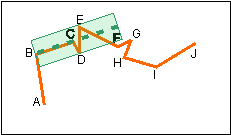
In this case, when the line is extended in the direction defined by BC, several points fall within the tolerance.
All points within the tolerance except the first and last are deleted. In this case, points C and D are deleted.
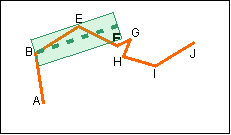
A new strip is drawn to follow line segment EF.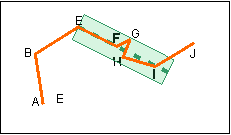
In this case, points E, F, G, H, and I fall within the tolerance. All of these except the first and last (E and I) are deleted.
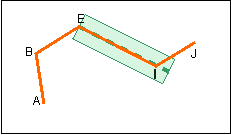
A new strip is drawn to follow line segment IJ.
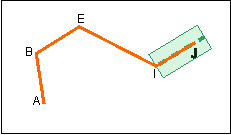
No points except the first and last fall within the tolerance, so no points are deleted.
The simplified line looks like this: